
Three Antrim County Docket Custodians
Antrim County splits its court records across three offices. The Antrim County Clerk holds the files of the 13th Circuit Court. Those files cover criminal, civil, and family cases. The 86th District Court Antrim office runs its own stream of cases. That stream covers criminal, traffic, civil, small-claims, and summary matters. A third stream sits with Probate Court and the Family Division. Those offices track estates, guardianships, conservatorships, and protected family matters. Figure out the court first. Picking the wrong office wastes a whole search.
Administration is shared regionally, but the counters you deal with are local to Bellaire. A felony often begins in district court with an arraignment or preliminary examination. It then moves to circuit proceedings. Civil claims follow jurisdiction too. The District Court handles disputes up to $25,000; anything larger goes to the Circuit Court. Village records stay separate, even when a citation started with a village ordinance.
The Circuit Court Section and the 86th both confirm public-access terminals at the courthouse. Use them for reviewing records or case indexes. Details like terminal count, reservations, and printing rules are not published. Just ask at the counter. If you need a certified copy or protected-access review, that becomes a separate request.
The Antrim County government homepage lays out the county services. Those services lead to these courts and the clerk.
That service map matters. An Antrim County docket question usually turns on choosing the right court office, not just typing a name into a search box.
How to Search the Antrim County Court Docket
Start with MiCOURT Case Search. It is the statewide portal for public civil, traffic, criminal, domestic, and probate records when a court makes them available. It shows case history; it does not replace the official file. Begin with the court named on your notice, citation, or pleading. If the case does not appear, try the clerk. You can also try a public terminal or the court's own display. Never assume the case does not exist.
Use the case number if you have it. A party-name search works when the number is missing, but misspellings, court selection, access limits, and recent filings all skew the results. Keep your paper notice close. Then you can check the court, case type, and next setting against what the screen shows.
- Identify whether the matter belongs to 13th Circuit, 86th District, or Probate and Family.
- Open MiCOURT and select the court before beginning the Antrim County docket search.
- Search by last name with optional first name and birth year, or use the year, number, and type from the case number.
- Read the case history for filings, status, and any next-hearing field that the court displays.
- Use the relevant clerk counter or public terminal for a missing result, a filed document, or a certified copy.
A public result is informational; the court that keeps the file is the source for an official record or a question about a current setting.
Antrim County MiCOURT Case Search
MiCOURT keeps name searches and case-number searches apart. For a name search, the public screen first asks you to pick a court, then offers Last Name or Business, First Name, Middle Name, and Birth Year. The case-number panel takes Case Year, Case Number, and Case Type. That court selector carries real weight. One portal covers many court streams. Enter only what the public search asks for, nothing more.
| MiCOURT field | Use for an Antrim County docket search |
|---|---|
| Select court | Choose the relevant Antrim court when listed. |
| Last Name or Business | Required starting field for the public name search. |
| Birth Year | An optional narrowing field, not a request for a full date of birth. |
| Case Year, Number, Type | Use the components exactly as printed on the notice or case material. |
The Antrim County courts page distinguishes the Circuit, District, and Probate and Family functions.
So the portal's structure does the filtering first. That helps a lot when all you hold is a brief notice or citation.
What a Court Docket Shows
Michigan may call the public chronological display a case history. The formal record goes by register of actions. The label matters less than the limits. An Antrim County court docket indexes recorded events; it does not promise every document online. What you see depends on the court and the case type. Public access rules matter too, and so does whether a hearing or filing has been entered.
| Case number | The court’s identifier, often searched by Year, Number, and Type. |
|---|---|
| Case and parties | The court, case type, case caption or party roles, and judge when public display permits. |
| Case history | Dated filings, orders, hearings, pleas, judgments, and other recorded events. |
| Next setting | A future hearing date, time, room, or setting type where the court exposes it. |
| Status or disposition | A current status or recorded outcome, which should be read with the later entries. |
| Restrictions | Masked information or an absent record where a rule, order, or statute limits public access. |
Read the entries in order, with care. A later entry can reset the live date or explain an earlier filing, yet the earlier event still stands.
Antrim County Docket Terms
Brief displays read better in plain language. A case history lists actions by date. It is not necessarily an image of the filed paper. The next-hearing field and the calendar do different jobs, and the register of actions shows the wider run of filings and orders behind any scheduled row.
- Docket or case history
- The chronological list of court events in a case.
- Register of actions
- The formal court record of actions and events, a term used in Antrim Probate materials.
- Disposition
- The recorded outcome or closing action for a case or charge.
- Continuance or reset
- A scheduled event moved to a later date; the older date can remain in the history.
- Certified copy
- A clerk-authenticated reproduction, different from a public web result.
Local abbreviations are not published anywhere. Confirm a short code with the responsible clerk instead of guessing at what it expands to.
Which Courts Keep Dockets
Court type decides the custodian of an Antrim County docket. It also decides the best way to search it. The 13th Circuit Court serves as the general-jurisdiction trial court for felonies, larger civil cases, and family matters. The 86th District Court takes traffic, civil infractions, and misdemeanors. It also handles civil cases within its jurisdiction, small claims, and summary proceedings. Probate and Family records carry their own access limits and office channels.
| Court | Docket covers | Where to search |
|---|---|---|
| 13th Circuit Court | Felony, circuit civil, and family division matters. | MiCOURT, the County Clerk’s court section, circuit terminal, or the official circuit link. |
| 86th District Court | Traffic, misdemeanors, civil infractions, civil matters up to $25,000, small claims, and summary proceedings. | MiCOURT, Court Display, Antrim WebTeCS when eligible, or the Antrim counter. |
| Probate Court and Family Division | Estates, trusts, guardianships, conservatorships, and protected family or juvenile matters. | MiCOURT where public, the dated docket link, or the Probate and Family office. |
The Probate Court and Family Division runs a record channel of its own. It is not an arm of the 86th District docket.
That office keeps separate docket and payment references, which is why court selection comes before any record request.
Antrim County Court Display Dates
The 86th Court Calendar posts named Antrim displays for Judge Cooney, Judge Stepka, pretrial, and the magistrate. Think of a public Court Display as a date-oriented view, not a full case search. Its fields are Party Name, Time, Room, and Case Number, with date navigation and pagination. For the broader case history, go through MiCOURT or the clerk.
Scheduling works differently by court. For a Circuit setting, the Court Administrator calendars hearings and referees' matters while the County Clerk keeps the file. For probate or protected family matters, call the Probate and Family office. Old dates can linger in the history after a reset, so weigh the latest entry against the current display and your paper notice.
The county's annual-report index likewise splits reporting among Circuit, District, Probate and Family, and Clerk functions.
The separate reports match the separate Antrim County docket streams a date search has to tell apart.
Finding Court Dates and Settings
Begin with the paperwork you already hold. The citation, the signed order, or the newest notice beats anything else. Check that against MiCOURT next-hearing information when it is available. Also check the right 86th Court Display. A calendar row can list the time, room, party, and case number. It still cannot replace a signed order. Watch for a setting that vanished from the list. An adjourned, continued, rescheduled, reset, or notice-of-hearing entry may explain the change.
Phone lines settle the rest. District matters that fail to appear, or that need confirmation, go to the Antrim 86th District Court at 231-533-6441. Circuit case dates belong to the County Clerk at 231-533-6353. Shared circuit administration sits at 231-922-4701. Probate and Family date questions ring 231-533-6681. The full Antrim County court calendar page walks through those date channels in more detail.
A court date can change after a calendar was viewed, so retain the notice and ask the court which setting is current when the sources differ.
Antrim County Court History
Antrim County dates to 1863. The county seat shifted to its geographical center in 1879. The historic courthouse rose in 1905. Staff moved into the present county building in 1978, and county history also marks 1867 for the first recorded births, deaths, and marriages. None of that puts an early court file online. It simply explains something practical. An older Antrim court record may call for a clerk, an index, or a storage inquiry at the courthouse.
The official county history lays out the courthouse and county-building timeline.
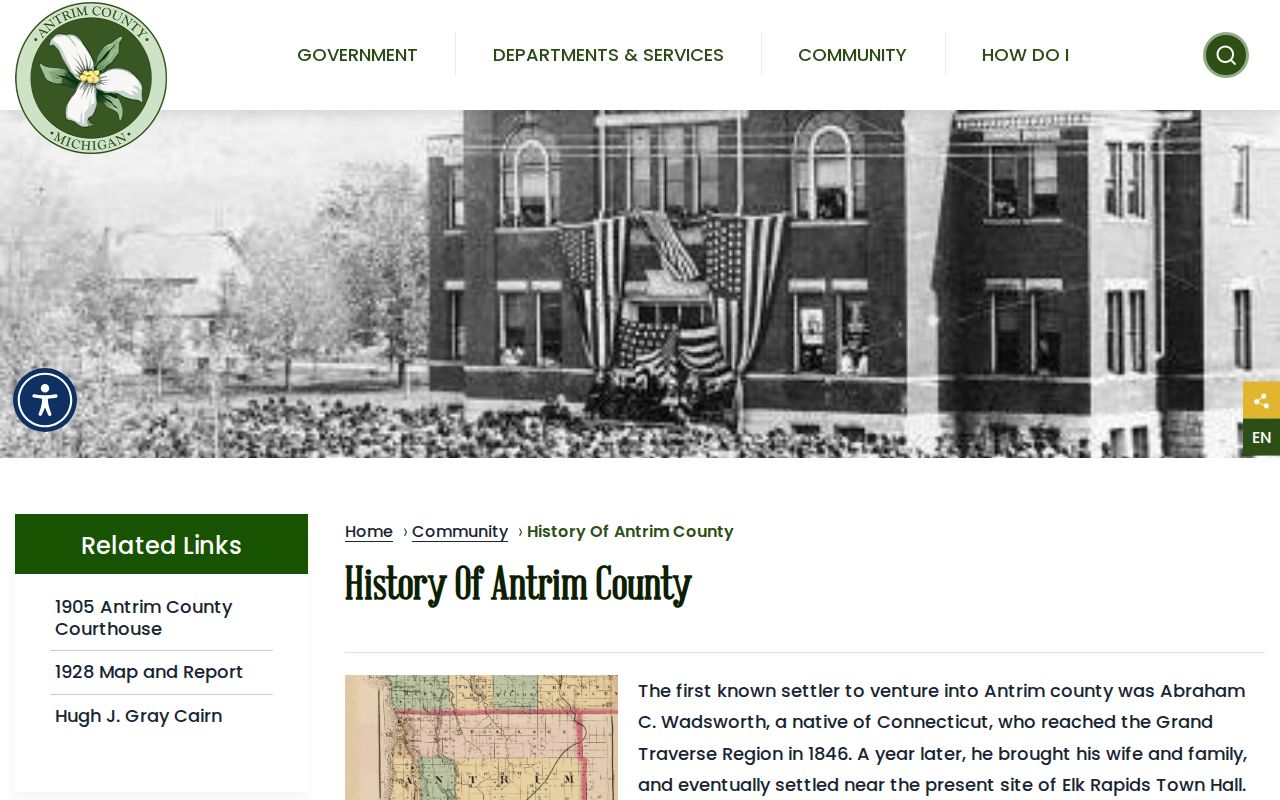
Modern case history helps with current matters. An Antrim County court docket search for older material still tends to end at a courthouse record counter or a stored file.
Public Access to Dockets
Michigan opens its court records to the public. A law, court rule, or court order can say otherwise. Court files travel a different road than county administrative records under the Michigan Freedom of Information Act. The judicial branch answers to its own rules. Start with the case-history search. Then take any court-file request to the clerk who actually holds the record.
Key Michigan access rules:
Michigan Court Rule 8.119(H) explains that a clerk cannot let a case record leave the court without an order and addresses access to court records.
Michigan Court Rule 1.109(D)(9) governs protected personal identifying information in public documents and access systems.
Michigan FOIA, MCL 15.231 et seq. covers county administrative records, while court-file requests go through the responsible court.
MCL 712A.28 limits general public access to juvenile records subject to statutory exceptions.
Adoption, juvenile, mental-health, PPO, and similar protected matters may be missing or limited in public docket results. An empty result does not prove a court matter never existed.
Antrim County MiFILE and Dockets
MiFILE is an electronic filing and service system for registered filers. It is called TrueFiling in the 13th Circuit transition materials. It is not a free public docket substitute. The 13th Circuit moved to MiFILE in 2018. Current support material warns that a missing filing can force a person to proceed in person or by mail while support works the problem. Keep the roles straight. A filing receipt and a public case history serve different purposes.
The 13th Circuit e-filing information covers the MiFILE transition and the court-specific support path.
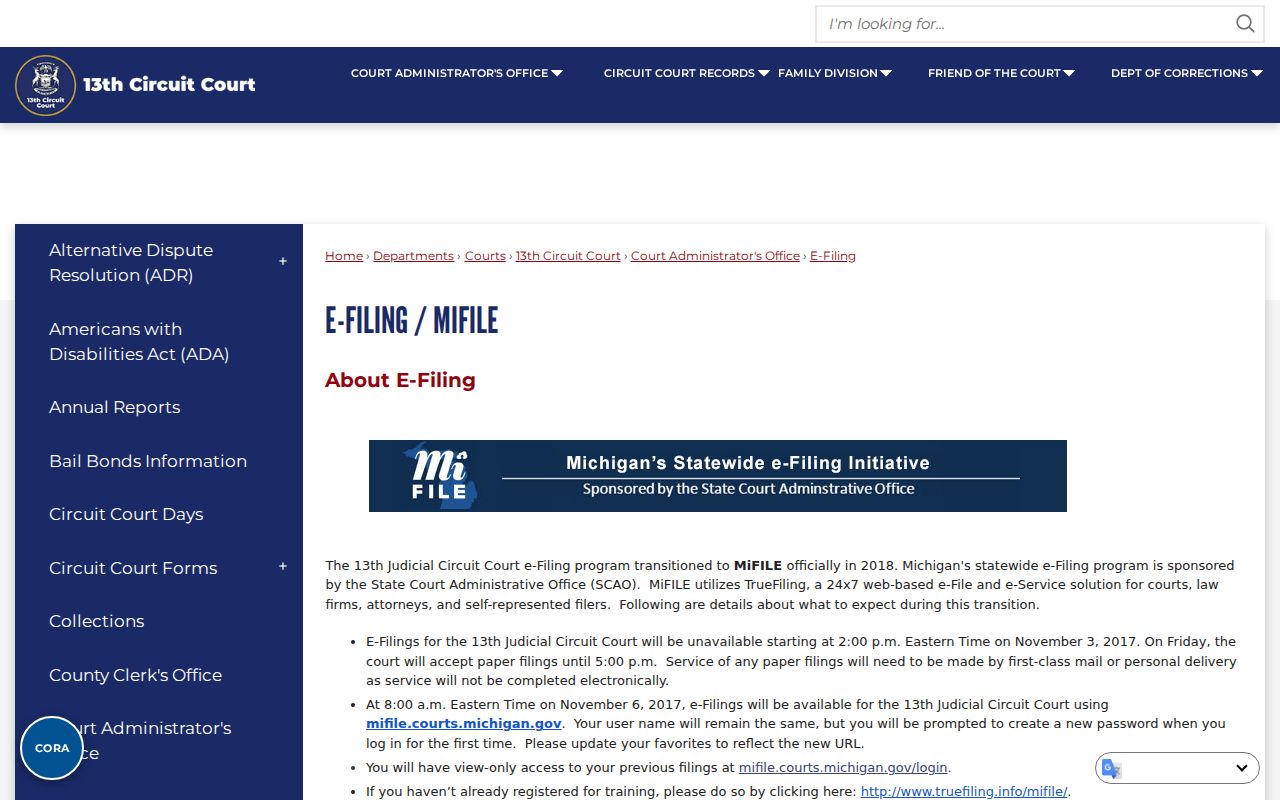
For an Antrim County docket search, lean on the public case-history and clerk channels. Save MiFILE for the filing function the court actually supports.
The Clerk and Docket Records
The Antrim County Clerk serves as clerk of the Criminal, Civil, and Family divisions of the 13th Circuit Court. The court section stores files, accepts or rejects filings, and handles the money records. It also indexes court records and grants access as the law allows. Public computer terminals there let visitors review court records on site. For a Circuit record, a filed document, or a certified clerk copy, this office is the right first stop.
The 86th District Court keeps District files at its own Antrim office. Its File Review and Copy Request covers courthouse index access and in-person, review-only requests. Whatever you ask for, name the case number, document, or party. Be as precise as you can.
The County Clerk’s official page posts the court-section contact information.
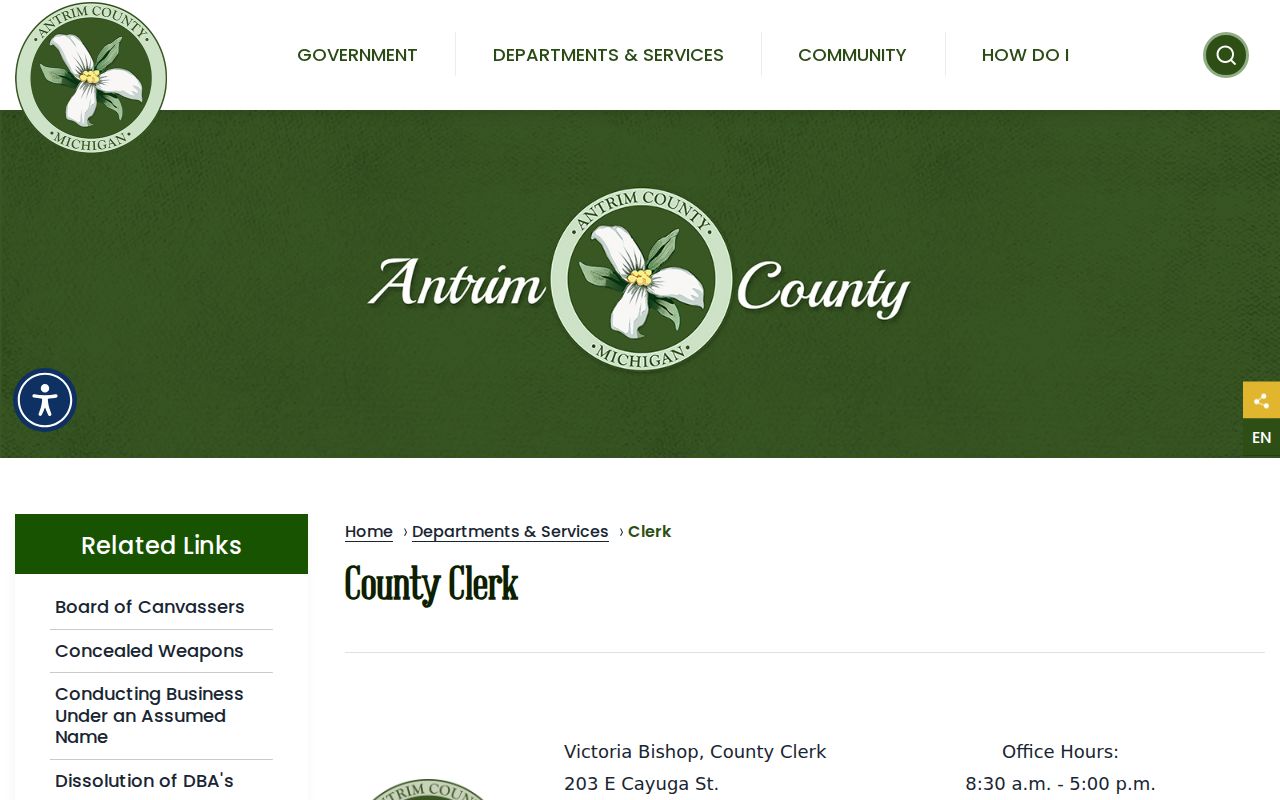
Those listed duties explain the pattern. A public docket entry, a requested document, and a certified copy may each take a different path through Antrim County record steps.
Antrim County Clerk Court Section
203 E. Cayuga Street, P.O. Box 520
Bellaire, MI 49615
231-533-6353
Antrim County Court Docket Filing Context
An August 2024 county board packet reported 418 new cases in a Circuit Court summary. The breakdown was 47 civil, 70 criminal, 292 family, and 9 appeals. Read those figures carefully. The count covers new circuit cases only. It is not every Antrim County court combined, not pending matters, and not District Court tickets. It does show family matters leading that particular Circuit summary by a wide margin.
The Antrim annual-report index lists separate 2025 reports for the Circuit Court, 86th District Court, Probate and Family Court, and County Clerk. Separate documents drive home the local rule. Seek each Antrim County docket through the court system that keeps it.
Both the 13th Circuit and the 86th District are shared three-county systems. They serve Antrim, Grand Traverse, and Leelanau. Some administration and web resources therefore point to Traverse City. Even then, an Antrim matter belongs with a Bellaire clerk or counter. Trust the court and case type shown in the record itself over a general location label.
Court Dockets by City in Antrim County
The cited census table lists no incorporated place legally called a city in Antrim County. Five incorporated villages stand in as city-equivalent docket pages. The project calls for the top five communities. None of the five runs its own municipal court portal. For an ordinary village traffic or ordinance question, read the citation. Start with the 86th District Court unless another court is named.
Elk Rapids Court Docket
1,529 residents in the 2020 Census · village matters route to the District Court structure.
Mancelona Court Docket
1,344 residents in the 2020 Census · no separate municipal docket was located.
Bellaire Court Docket
1,053 residents in the 2020 Census · county-seat court offices keep distinct records.
Central Lake Court Docket
960 residents in the 2020 Census · village administration is separate from a court register.
Ellsworth Court Docket
367 residents in the 2020 Census · check the citation for the named court.
Map and Directions to the Antrim County Courthouse
The 13th Circuit Court's files are kept at the Antrim County Clerk's Court Section, 203 E. Cayuga Street in downtown Bellaire, the county seat since 1879. The Clerk's page says the Court Section has public computer terminals for reviewing court records, the strongest documented in-person fallback when a case does not turn up online. The 86th District Court and Probate/Family Division share the same courthouse block at 205 E. Cayuga Street.
Antrim County Clerk Court Section
203 E. Cayuga Street, P.O. Box 520
Bellaire, MI 49615
231-533-6353
Monday-Friday, 8:30 a.m. to 5:00 p.m.
86th District Court & Probate/Family Division
205 E. Cayuga Street
Bellaire, MI 49615
231-533-6441
A secure drop box for Probate/Family filings sits outside the County Building's southeast entrance off M-88. County pages give conflicting street numbers for the courthouse block (203 versus 205 E. Cayuga), so confirm the office and address by phone before a first visit. No official page documents security screening, ADA routes, or parking rules, so ask the clerk about those when you call.